
Charcoal Briquettes: The Connoisseur’s Guide to Consistent BBQ Heat in 2026 - The BBQ Experts
Charcoal Briquettes: The Connoisseur’s Guide to Consistent BBQ Heat in 2026
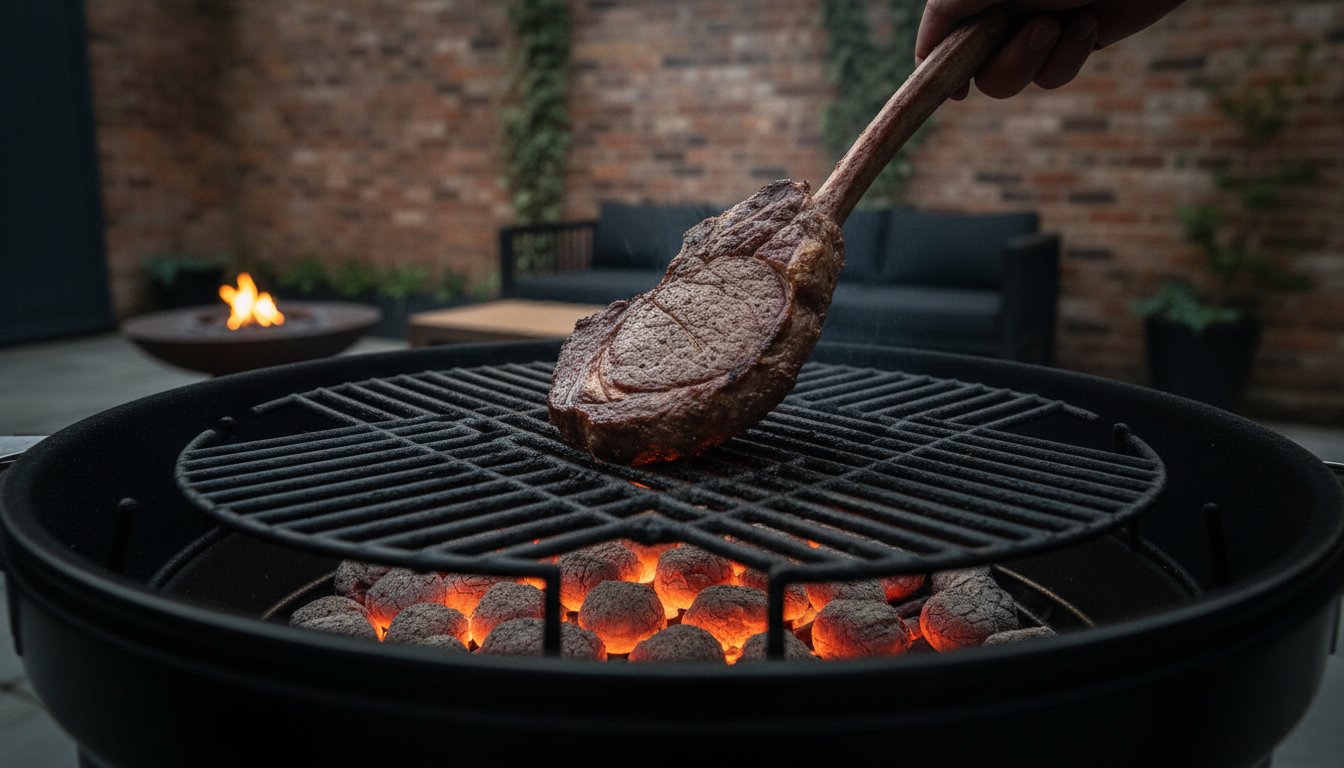
Your £120 dry-aged Tomahawk steak deserves better than the unpredictable flare-ups and acrid chemical smoke of budget fuel. While many traditionalists still cling to the romance of irregular lumpwood, the most discerning UK pitmasters are shifting their focus toward the engineered excellence of premium charcoal briquettes to achieve culinary perfection. You know the disappointment of watching a carefully prepared meal suffer because your heat levels plummeted just as the searing process began. It’s a frustration that can turn a relaxed Sunday afternoon into a stressful kitchen rescue mission.
This guide promises to show you how to master precision temperature control and select the finest, high-density fuels that burn for up to 12 hours without a single puff of bitter smoke. We’ll explore the specific technical innovations in 2026 that allow these uniform fuel sources to provide an unrivaled, clean flavour profile for your outdoor kitchen. From understanding compression ratios to identifying the bespoke binders used by elite brands, you’re about to elevate your outdoor cooking to a professional standard that makes your garden the ultimate social hub.
Key Takeaways
- Understand the evolution of premium charcoal briquettes, discovering how carbonised wood and natural binders create a clean, chemical-free foundation for your outdoor sanctuary.
- Master the “Low and Slow” technique by learning why consistent fuel density is the secret to achieving succulent, perfectly roasted joints every time.
- Explore the science of the steady burn to gain unrivaled precision over your grill’s temperature, ensuring your culinary masterpieces are never left to chance.
- Unlock professional fuel management secrets, including the essential role of the chimney starter and advanced arrangements like the “Snake Method” for prolonged cooking sessions.
- Elevate your outdoor cooking experience by pairing premium oak fuels with high-end hardware to achieve the ultimate in heat retention and sophisticated flavour.
Understanding Charcoal Briquettes: More Than Just Compressed Coal
For the discerning outdoor chef, the choice of fuel is as critical as the cut of meat selected from the butcher. While many novices dismiss charcoal briquettes as mere utility items, the seasoned pitmaster understands they are a precision-engineered component of a perfect sear. A modern, high-grade briquette consists of carbonised wood compressed with natural binders, creating a dense energy source that offers unrivaled reliability. This is not the acrid, chemical-scented fuel of the past. It is a refined tool designed for those who view their garden as a sanctuary for culinary excellence.
The manufacturing process of charcoal briquettes has evolved significantly since their commercial rise in the 1920s. We often encounter the misconception that all compressed fuels contain harmful additives or petroleum-based starters. In reality, professional-grade oak briquettes rely on high-pressure extrusion to achieve their form. This uniform shape is the secret to predictable airflow. When every piece of fuel is identical, you gain total control over the oxygen paths in your grill, leading to a steady heat distribution that lumpwood simply cannot match.
The Anatomy of a Premium Briquette
Quality is defined by carbon content. Professional-grade fuel often boasts a fixed carbon level exceeding 80 percent, which translates to a cleaner burn and minimal ash production. We avoid budget bags that rely on synthetic glues. Instead, look for starch-based binders like corn or potato starch. This natural approach ensures your succulent ribeye is never tainted by off-flavours. Density remains the final pillar of performance. A heavy, compressed block retains heat for 3 to 5 hours, providing the steady thermal mass required for complex, low-and-slow cooks.
Briquettes in the Modern Outdoor Kitchen
The arrival of high-performance ceramic Kamado grills and precision Hibachis has transformed our fuel requirements. These sophisticated vessels demand consistency to maintain their bespoke cooking environments. Using premium charcoal briquettes allows you to master airflow with surgical precision, as each uniform block behaves exactly like the last. This predictability is the foundation of the Expert Mentor philosophy; it removes the guesswork from your Sunday roast.
Beyond the culinary results, high-quality fuel protects your hardware investment. Low-ash, high-purity carbon prevents the build-up of corrosive residues inside your Napoleon or Kamado Joe. This ensures your outdoor kitchen remains a masterpiece for decades. To elevate your outdoor cooking, you must start with a foundation of fuel that respects the craftsmanship of your grill. Choosing a dense, oak-based briquette is the first step in transforming a simple meal into a sensory event.
Briquettes vs Lumpwood Charcoal: The Ultimate Performance Comparison
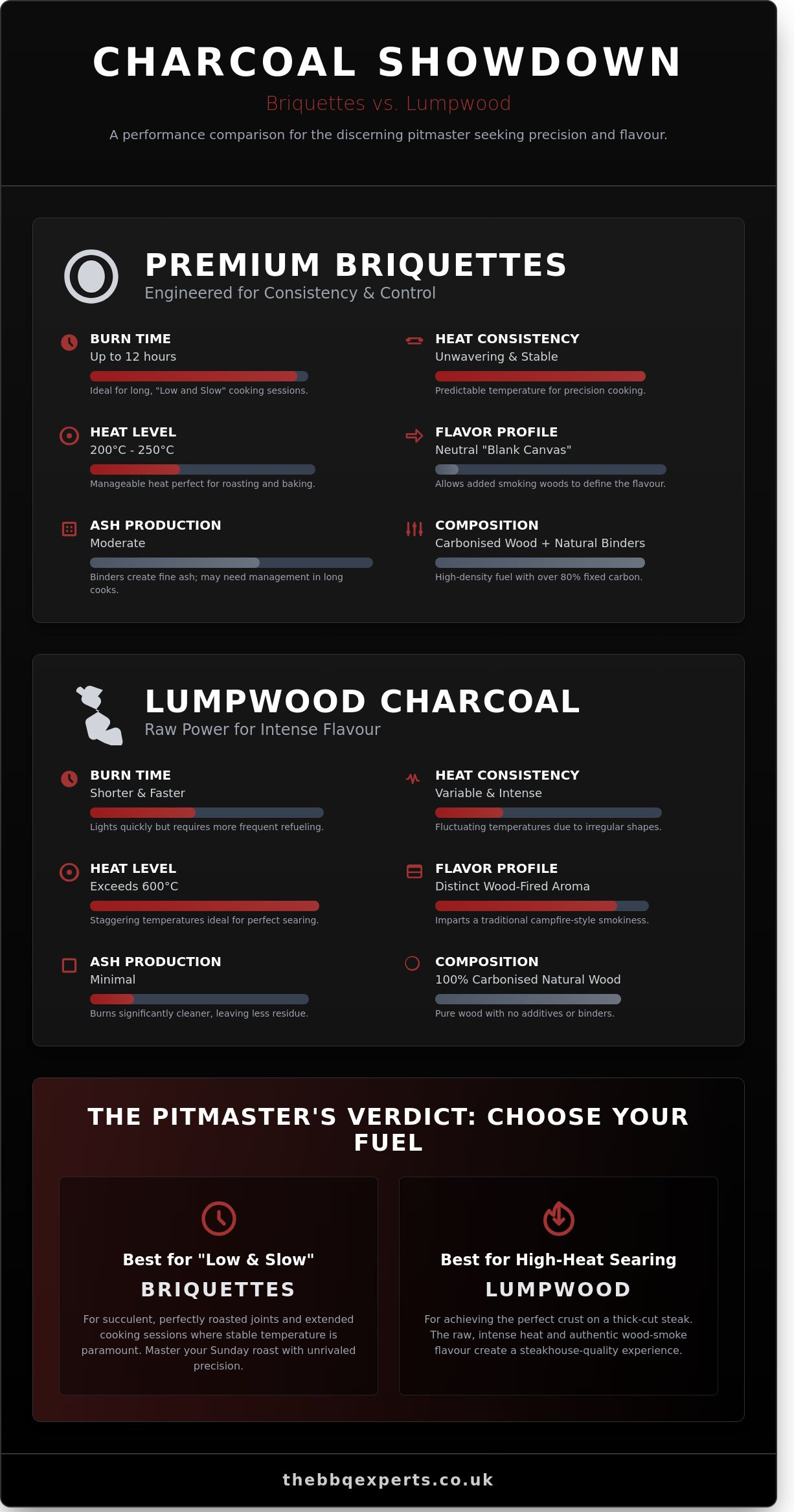
Mastering the fire requires understanding how these two fuels behave under the lid. While lumpwood offers raw, untamed heat, charcoal briquettes provide the unwavering consistency needed for culinary precision. Data from rigorous testing on Briquettes vs Lumpwood Charcoal performance shows that briquettes can maintain a steady temperature for up to 12 hours. This stability makes them the undisputed kings of the “Low and Slow” session, where a fluctuating thermometer is the enemy of a perfect cook.
Lumpwood burns at staggering temperatures, often exceeding 600°C, which is ideal for searing a thick ribeye to perfection. In contrast, briquettes usually settle into a manageable range of 200°C to 250°C. You’ll also notice a difference in the sensory experience. Lumpwood imparts a distinct, wood-fired aroma that evokes traditional campfire cooking. Charcoal briquettes are intentionally neutral. This neutrality acts as a blank canvas, allowing your choice of added smoking wood chunks to define the flavour profile of the meat.
One technical detail often overlooked is ash production. Briquettes contain binders that leave behind a fine, grey powder as they consume. In certain barbecue designs, such as smaller ceramic kamados, this ash can accumulate and restrict oxygen flow during a long 10-hour cook. Lumpwood burns significantly cleaner, leaving minimal residue and keeping your airflow pristine for the duration of the bake.
When to Reach for the Briquettes
Briquettes are your best ally for complex, long-form cooks like smoking a 6kg brisket or roasting a succulent whole chicken. Their uniform shape guarantees a predictable heat curve that doesn’t require constant vent adjustment. This precision is vital when using vibrant Angus & Oink rubs. The steady temperature prevents the delicate sugars and spices in the rub from scorching, ensuring a perfect bark without any bitter notes. Beginners find that briquettes simplify the learning curve, removing the frustration of “temperature spikes” from the equation.
The Lumpwood Alternative
For those seeking professional-grade results, Big K Marabu Charcoal is a revelation for the home enthusiast. This “restaurant grade” fuel is carbonised from dense hardwoods, offering a burn time that rivals many briquettes while retaining the high-heat capabilities of traditional lumpwood. It’s the secret weapon for a high-heat sear that locks in juices instantly. If you want the best of both worlds, try the expert strategy: build a base of briquettes for longevity and top it with a layer of Marabu for an initial intense heat. You can elevate your outdoor cooking today by selecting the fuel that matches your culinary ambition.
The Science of Sustained Heat: How Briquettes Power Your BBQ
Precision is the hallmark of a master pitmaster. While lumpwood offers raw intensity, charcoal briquettes provide the mathematical certainty required for a perfect low-and-slow cook. This reliability stems from carbonisation, a process where wood is heated in an oxygen-depleted environment. This thermal treatment strips away volatile gases and water, leaving behind a fuel source with a much higher carbon concentration than raw timber. The result is a dense, energy-rich nugget that burns with a clean, predictable heat profile.
The secret to their endurance lies in the physics of the “steady burn.” Because each briquette is manufactured to a uniform size and shape, the surface area to volume ratio remains constant across your entire fuel bed. This uniformity prevents the unpredictable temperature spikes often found with irregular lumpwood shards. Moisture content also plays a vital role; premium fuels are dried to approximately 5% moisture, whereas budget alternatives often sit at 15% or higher. Lower moisture ensures that energy isn’t wasted evaporating water, leading to less acrid smoke and a more efficient combustion cycle.
The thermal mass of a briquette represents its capacity to store heat energy, functioning as a radiant battery that maintains internal pit temperatures and ensures rapid heat recovery after the lid is opened to baste your meat.
Binders and Fillers: What Are You Really Burning?
The ingredients inside your fuel dictate the flavour of your feast. High-end charcoal briquettes use food-grade corn starch as a binder, which burns away cleanly without affecting the aroma of your succulent ribeye. In contrast, cheaper options often rely on industrial adhesives or chemical accelerants that produce a pungent, “off” flavour and excessive amounts of fine white ash. Professional-grade fuels prioritise quality by using a higher percentage of hardwood sawdust, ensuring your garden sanctuary is filled with the scent of authentic wood smoke rather than acrid chemicals.
Sustainability and Sourcing
Choosing the right fuel is an investment in the future of the outdoor cooking hobby. In the UK market, looking for the FSC (Forest Stewardship Council) certification is essential to ensure your charcoal comes from responsibly managed woodlands. Sustainable sourcing protects local ecosystems and ensures that our passion for fire doesn’t come at the cost of the environment. High-density briquettes are inherently more sustainable because they pack more energy into a smaller volume, reducing transport emissions and resulting in significantly less waste at the end of your cook. This mindful approach allows you to elevate your outdoor cooking while supporting the longevity of British woodland traditions.
Master the Burn: Practical Tips for Lighting and Managing Briquettes
Achieving a flawless sear or a 12-hour low-and-slow brisket isn’t down to luck; it’s a matter of physics and precision. While lumpwood offers raw power, charcoal briquettes provide the steady, predictable heartbeat required for culinary masterpieces. Mastering this fuel source transforms your garden from a simple patio into a professional-grade outdoor kitchen.
The chimney starter is your most vital companion in this journey. It eliminates the need for chemical accelerants, ensuring your food tastes only of the smoke and the quality of the meat. For long-duration cooks, you must look beyond simply dumping fuel into the basin. The “Snake Method” involves lining your fuel in a semi-circle around the edge of the grate, allowing the fire to travel slowly like a fuse for up to 12 hours. Alternatively, the “Minion Method” places a few lit coals atop a pile of unlit fuel, creating a controlled, gradual burn that is perfect for vertical smokers and ceramic grills.
The 15-Minute Lighting Routine
Efficiency is the hallmark of a seasoned pitmaster. To light your fuel with surgical precision, follow these steps:
- Place two or three natural wood-wool firelighters on the bottom grate of your BBQ.
- Fill your chimney starter with the required amount of fuel and place it directly over the firelighters.
- Wait for the “ashing-over” stage. You’ll know the charcoal briquettes are ready when the top layer is covered in a delicate grey dust and the glow is visible through the vent holes.
Avoid the temptation to pour the coals out too early. Prematurely dumping the fuel often results in heavy, acrid white smoke that imparts a bitter “dirty” flavour to your ingredients. Wait for the smoke to turn thin and blue before you begin cooking.
Advanced Temperature Control
Managing heat is a delicate dance between oxygen intake and exhaust. Your bottom vents act as the accelerator, pulling in oxygen to intensify the burn. The top vents function as the chimney, drawing smoke across the food and fine-tuning the internal environment. If your temperature begins to dip during an eight-hour smoke, don’t panic. Simply add unlit fuel to the edges of your existing fire; the established embers will ignite the new pieces gradually without causing a sudden spike.
Expert mentors always advocate for a dual-probe digital thermometer. One probe monitors the ambient temperature at the grill surface, while the other tracks the internal temperature of your succulent roast. This data allows you to make micro-adjustments to your vents before the heat drifts too far from your target. Never use lighter fluid. It’s a culinary sin that taints your bespoke outdoor sanctuary with the smell of kerosene and ruins the integrity of your cook.
British weather is notoriously fickle. Moisture is the nemesis of high-quality fuel. Store your bags in a weather-sealed, airtight container rather than a damp garage to ensure they remain bone-dry and ready for your next gathering. Elevate your outdoor cooking by exploring the professional-grade tools available at The BBQ Experts.
Elevating Your Fuel: Why Premium Oak Briquettes Change the Game
Choosing your fuel isn’t a secondary thought; it’s the defining moment of your cook. Premium oak briquettes represent the pinnacle of this choice, offering a dense, reliable energy source that retains heat for extended periods. Unlike standard supermarket options that crumble and fade, these high-density blocks provide a consistent thermal output that can last for over 240 minutes of intense searing. This stability is essential for the discerning chef who demands absolute precision over their fire.
The sensory experience of using high-quality charcoal briquettes is unrivalled. You’ll notice the clean, subtle aroma of seasoned oak wafting through your garden sanctuary, a scent that complements rather than masks your ingredients. This purity ensures your wagyu steaks or heritage pork chops develop a consistent golden colour and a bark that shatters perfectly. By integrating this fuel with professional hardware like a Hibachi Grill, you create a bespoke cooking environment where the heat is distributed with surgical accuracy across every centimetre of the grate.
The BBQ Experts Selection
Our curation process is rigorous. We only recommend brands like Big Eds because they meet our exacting standards for purity, often featuring an ash content of less than 3 per cent. This means less cleanup for you and significantly more airflow for your grill. There’s a powerful synergy between high-quality fuel and professional equipment. Even enthusiasts who prefer the convenience of Gas BBQs often utilise these briquettes in hybrid smoker trays to achieve that authentic wood-fired depth. It’s a simple way to elevate your outdoor cooking and transform your garden into the primary social hub of your home.
Your Next Step to BBQ Mastery
True mastery requires the right foundation. We encourage you to experiment with different fuel arrangements, perhaps mixing oak with fruitwoods to find your signature flavour profile. Explore our full range of professional-grade tools and bespoke seasonings to complete your setup. Quality charcoal briquettes are the bedrock of every successful outdoor meal. By investing in premium fuel, you’re not just buying heat; you’re securing the success of your next culinary masterpiece. Don’t settle for average when you can achieve excellence with every sear.
Master Your Flame for the 2026 Outdoor Season
Achieving a flawless sear or a 12-hour low-and-slow smoke requires more than just technique. It demands fuel that performs with absolute precision. You’ve discovered how the uniform density of premium charcoal briquettes provides the unwavering thermal stability needed to transform your garden into a professional-grade outdoor kitchen. By choosing high-performance options like our dense oak varieties, you ensure a cleaner burn and a more refined flavour profile that standard alternatives simply cannot match. Consistency is the secret behind every succulent, competition-standard brisket.
As specialist UK retailers, we’ve spent years curating a selection that meets the exacting standards of the modern pitmaster. From the unrivalled heat of Big Eds to our sustainably sourced Oak Briquettes, every product in our range is chosen for its ability to deliver bespoke, professional-grade results. We’re passionate about high-performance fuels that respect the environment while powering your culinary sanctuary. It’s time to invest in the quality craftsmanship your cooking deserves. You’ve the skills and the vision; now ensure you’ve the best tools for the job.
Elevate your outdoor cooking with our premium charcoal collection and start your journey toward BBQ mastery today.
Frequently Asked Questions
Are charcoal briquettes better than lumpwood for smoking?
Charcoal briquettes are superior for smoking because they provide an incredibly steady, predictable heat for 8 to 12 hours. While lumpwood offers a high-intensity sear, the uniform shape of briquettes ensures your brisket or pork shoulder stays at a constant 110°C. This reliability transforms your garden into a professional-grade smokehouse. You’ll spend less time fiddling with vents and more time enjoying the anticipation of a succulent, slow-cooked masterpiece.
How long do charcoal briquettes take to light in a chimney starter?
You can expect your charcoal briquettes to be ready for cooking in 15 to 20 minutes when using a chimney starter. Look for the distinct layer of white ash covering the top fuel layer; this signals that the core is glowing and ready to deliver unrivaled heat. This precise timing allows you to prepare your bespoke rubs and marinades without rushing, ensuring every element of your outdoor feast is curated to perfection.
Can I reuse partially burnt briquettes for my next barbecue?
You can certainly reuse partially burnt fuel if the pieces remain structurally sound and haven’t crumbled into dust. Simply close your grill vents completely to starve the fire of oxygen, then shake away the excess ash before your next session. Reusing fuel is a hallmark of the savvy connoisseur who values both efficiency and quality. It’s an excellent way to maintain your outdoor sanctuary while ensuring no premium resource goes to waste.
Do charcoal briquettes contain harmful chemicals or additives?
Premium charcoal briquettes use natural corn or potato starch as a binder rather than the harsh chemicals found in budget alternatives. We recommend choosing brands that specify “all-natural” to ensure your succulent ribeye isn’t tainted by petroleum or coal dust aromas. High-quality fuel protects the integrity of your culinary creations. It ensures that the only scent wafting through your garden is the rich, evocative aroma of authentic wood smoke.
How many briquettes do I need for a typical 4-hour cook?
For a 4-hour low and slow cook at 110°C, you’ll typically require 50 to 60 briquettes in a standard 57cm kettle grill. This quantity provides a stable thermal mass that holds temperature without constant intervention. If you’re searing at high heat for that same duration, you might increase this by 20 percent. Mastering these ratios is the first step to becoming a true expert in the art of outdoor gastronomy.
What is the best way to store charcoal briquettes in the UK?
Storing your fuel in a moisture-tight, heavy-duty plastic bin is essential in the damp UK climate. Humidity levels in Britain often exceed 80 percent, which can ruin the performance of your charcoal briquettes by making them difficult to light. Keep your supply in a dry garage or shed, elevated off the cold floor. This simple step ensures your fuel remains in peak condition, ready to elevate your outdoor cooking at a moment’s notice.
Why do my briquettes produce so much ash compared to lumpwood?
Briquettes produce more ash because they contain binders and fillers that don’t fully combust like pure wood does. A typical briquette might leave behind 10 percent of its weight in ash, whereas high-quality lumpwood often leaves less than 2 percent. This residue is a byproduct of the manufacturing process that gives the fuel its famous longevity. Just ensure you clear the ash catchers frequently to maintain the unrivaled airflow required for a perfect sear.
Can I use charcoal briquettes in a ceramic Kamado-style grill?
While you can use them, we advise against using briquettes in ceramic Kamado-style grills like a Kamado Joe. The high ash production can quickly clog the narrow air holes in the fire grate, suffocating the fire during long cooks. To achieve the best results in these bespoke outdoor ovens, stick to premium lumpwood. It provides the clean, intense heat and superior airflow that these high-performance machines were designed to harness.
Recent News & Updates

Our Story, Values and Beliefs
Here at the BBQ experts we have a passion for BBQ food, outdoor living and spending time with family and friends. We offer you; A...
Charcoal Briquettes: The Connoisseur’s Guide to Consistent BBQ Heat in 2026
Your £120 dry-aged Tomahawk steak deserves better than the unpredictable flare-ups and acrid chemical smoke of budget fuel. While many...